Solar power booming in the UK

So far in 2025, the UK has experienced record-breaking solar panel installations and solar energy generation, driven by high energy prices and government incentives.

Some Key Statistics for 2025

Installations: Over 120,000 certified solar panel systems were installed in the first six months of 2025, a 36-37% increase compared to the same period in 2024. Nearly 100,000 of these were domestic systems.

Total Capacity: As of April 2025, the UK had a total operational solar capacity of 18.1 GW across approximately 1,780,000 installations.

New Capacity Added: The UK is expected to add between 3 GW and 3.5 GW of new solar capacity in 2025 alone. Over 2 GW of new capacity was completed in the first half of the year, a record start to the year for a decade.

Energy Generation: The first half of 2025 saw record solar generation of 9.91 TWh, a 32% rise. Solar energy accounted for 11.6% of UK electricity generation in May 2025, a record monthly share.

Market Share: Around 1.6 million homes in the UK now have solar panels, representing about 5.5% of households.


The surge in installations is attributed to:

Lower energy bills: Solar panels can significantly reduce household electricity costs.
Government Initiatives: Schemes like the Future Homes Standard (making solar mandatory on new homes from 2027) and the 0% VAT rate on installations have made renewable technology more accessible. The government also published a “Solar Roadmap” in June 2025 to accelerate deployment.

Falling Costs: The average cost per kW of a home solar installation has been trending downwards since mid-2023.

Energy Independence: Homeowners and businesses are increasingly seeking ways to achieve energy independence and protection from volatile energy prices.

Conclusion 

For a typical 4kW residential solar panel system in 2025, the average installed cost is around £6,500. Prices can vary based on system size and location, generally ranging from £3,000 to £25,000. For more information on solar panel installations and potential savings, visit the Energy Saving Trust. Official data and statistics on solar deployment are available from GOV.UK.

Ukraine War & impact on Energy bills

The Russia-Ukraine conflict spurred a global energy crisis, leading to significant price surges. As a result we are entitled to ask ourselves, when the Ukrainian War ends to our energy bills. 

In short, if the Ukraine war ended, oil prices would likely come under downward pressure fairly quickly (more supply, weaker risk premium), but European gas prices would probably fall much less — and slowly — because Europe has already diversified away from Russian piped gas and political, contractual and infrastructure limits make a rapid return unlikely. The UK would see some relief in wholesale prices over months, but household bill changes would depend on contract timing and policy.

So whats the mechanics of it all? Oil is a globally traded commodity. An end to hostilities that leads to easing of sanctions (or higher Russian exports) instantly increases expected future supply and removes a “risk premium” priced into oil — this pushes global oil prices lower. Markets often price this in before/while talks proceed.

Gas is more regional and infrastructure-dependent. Europe’s ability too rapidly take large volumes of piped Russian gas depends on pipelines, contracts and political will — all of which are constrained. Europe has rebuilt supply diversity (LNG, pipeline re-routing, storage, demand reduction, renewables), so a peace deal doesn’t automatically restore the pre-2022 gas flows. That mutes the price reaction for European gas relative to oil.

As for LNG & global gas markets, any incremental Russian volumes that reach the market (pipeline or seaborne) would ease global LNG tightness, lowering spot LNG prices and feeding into European TTF over time — but timing is phased and depends on how Russia decides to sell and which buyers accept those volumes.

So with these global market mechanics in mind, we have three realistic scenarios (and their likely price outcomes)

In the first scenario, of fast full reintegration as sanctions eased. That is Western sanctions on Russian energy are rapidly eased, Russian oil and (to a lesser extent) gas flows return to pre-crisis channels with OPEC & Russia possibly coordinate, their response. 

The likely impact for oil is a noticeable fall in oil prices (removal of risk premium + extra volumes). With gas, there would be some downward pressure globally, but modest in Europe because pipeline reversals and acceptance by buyers take time. In short, we would have short-term market swings and the medium term depends on OPEC reaction. The market commentary already shows oil softening when peace talks progress.

The second scenario, is a partial unwind / ceasefire with limited trade normalisation. Here the fighting stops or reduces with limited relaxation of trade, but most sanctions or buyer reluctance remain. Russia sells more crude to discount markets (ie traders/third parties) but big European flows stay low. The likely impact here is oil modestly lower (some extra supply, but not a full restoration); European gas largely unchanged or slightly down — LNG supplies and storage remain main drivers. This is the most probable immediate outcome.

With a ceasefire only and political obstacles persist, the hostilities pause but sanctions and political barriers to buying Russian gas/oil remain. Russia may sell into distant markets but not reverse Europe’s diversification. As the likely impact here is oil may dip on sentiment but quickly stabilise; European gas barely changes — prices continue to reflect LNG flows, storage and weather. This is plausible and consistent with analysts saying Europe won’t quickly reverse course.

Globally oil markets will have the strongest and fastest impact. Prices will generally fall if the war ends and sanctions ease because global supply expectations rise and risk premia shrink. Though the magnitude is uncertain as markets will also react to OPEC+/Russia policy, as they may cut prices production to defend prices. Recent trading shows oil already sensitive to peace-talk headlines. Globally the gas / LNG market effect is slower. Additional Russian seaborne gas/LNG would ease global LNG tightness and lower spot LNG prices; but re-routing and commercial acceptance take time.

Europe

Wholesale gas (TTF hub in Netherlands) prices are likely only modestly lower in the near term. Reasons being 

(a) Europe has diversified (LNG, inter-connectors),

(b) pipeline infrastructure (Nord Stream) was damaged or politically unusable,

(c) many buyers and governments have explicit policy against resuming dependence.

This while storage levels and weather are still the dominant short-term drivers. The market reaction to peace-talk headlines has already been modest.

The wholesale electricity market follows gas but with lag, so power prices should soften if gas weakens materially.

As for industry and competitiveness, cheaper oil does reduce transport/fuel costs globally. Whilst lower gas helps energy-intensive industries if wholesale falls persist.

United Kingdom

What will happen here in the UK? Wholesale prices, would likely trend down if global oil and (to a smaller extent) LNG soften. The UK is part of the integrated European gas & power system, so a sustained fall in European wholesale would reach UK markets.

As for household bills, pass-through will depend on when fixed contracts roll, the price cap mechanism, and government interventions. So consumers won’t see an instantaneous proportional cut. A UK parliamentary briefing shows wholesale falls feed into price cap decisions with a lag.

Whilst sentiment moves fast, the fundamentals take months. Oil often reacts quickly to news; while gas in Europe is governed by physical constraints and storage, so the real effects are slower.

Yet policy & politics matter. Even if the war ends, political reluctance in the EU/UK to resume old energy ties (or conditions attached) would limit flows — that’s a key reason gas prices probably won’t crash back to pre-2022 levels. So consumers: expect gradual, not instant, bill reductions — check the timing of fixed tariffs and the Ofgem price cap cycles as well. 


So the likely timeline of impact is immediately in the days and weeks ahead, oil reacts down on optimism while gas reacts limitedly. In the short–medium – (1–6 months) – if sanctions/flows change materially, oil settles lower while LNG flows and contract resales gradually lower global gas prices.

Whilst in the medium–long (6–24 months): structural change dependent on formal trade normalisation and infrastructure (contracts, pipeline repairs, new shipping routes). Here Europe is likely to continue its diversification measures, so gas prices may not revert fully to old norms.

Finally the quick policy and market implications for businesses would be if your an energy-intensive industries you’ll have to monitor forward curves and LNG availability and consider hedging if you expect gradual price decreases but high near-term volatility. 

Budget 2025 – Energy bill measures

Budget 2025 introduced a shift of environmental and social levies from household energy bills to general taxation. This measure is expected to reduce typical dual-fuel bills by around £134–£154 from April 2026. Several alternative measures were proposed during debate but not adopted.

VAT on Domestic Fuel

A reduction or abolition of the 5% VAT rate would deliver an immediate and visible reduction in bills. However, the measure has substantial fiscal costs (estimated in the low billions annually) and is poorly targeted, with higher-income households receiving the same benefit as lower-income households. Additionally, the measure has a one-off price impact rather than improving structural affordability. For these reasons, the option was rejected.

Curbing Excess Profits / Windfall Tax Expansion

Further windfall taxation or direct interventions to cap supplier profits were considered. Such measures could generate revenue and respond to public concern, but they do not translate directly into lower retail prices because Ofgem’s price cap is cost-reflective. Additional taxation also risks deterring investment in network infrastructure and new generation capacity. Given the need for long-term stability, this was not pursued.

Reforming Ofgem’s Price-Cap Methodology

Proposals included amending standing charge calculations and altering how wholesale costs are passed through. While reforms may have merit, Ofgem’s methodology is technically complex and changes require extensive consultation. Rapid alterations risk destabilising the supplier market, as seen during the 2021–22 market failures. Government therefore maintained regulatory independence and avoided immediate structural changes.

Energy-Efficiency Schemes and Levy Reform

The Budget reallocates the cost of green levies to general taxation, improving fairness for low-income households who spend a higher share of income on energy. The government cited past delivery failures under ECO and committed to simplified, taxpayer-funded alternatives. Well-targeted efficiency programmes remain the most effective means of delivering durable reductions in household energy costs.

Conclusion

The government prioritised fiscal stability, structural fairness, and long-term regulatory predictability. Alternative measures each carry material drawbacks: VAT abolition is costly and poorly targeted; expanded windfall taxation risks investment; and rapid price-cap reforms risk market instability. Well-designed efficiency programmes represent the most sustainable path to lower bills.

Budget Day – impact on refurbishment & retrofit works

As today is the long anticipated Budget Day to be undertaken by Rachel Reeves, Chancellor of the Exchequer, we are entitled to ask what is the impact of VAT on refurbishment and retrofit works and what is the Budget is likely to include based on recent speculation and government direction? 

VAT Impact on UK Refurbishment & Retrofit Today

The Problem is the standard VAT rate on most repair, maintenance, and general renovation work remains at 20%. This is the core issue that industry groups (like the Federation of Master Builders) have campaigned against for years, as it creates an incentive to demolish and rebuild (which is zero-rated) rather than to retrofit. The 20% VAT is still a barrier clearly. 

Energy-Saving Materials (ESMs): Zero-Rated (0% VAT)

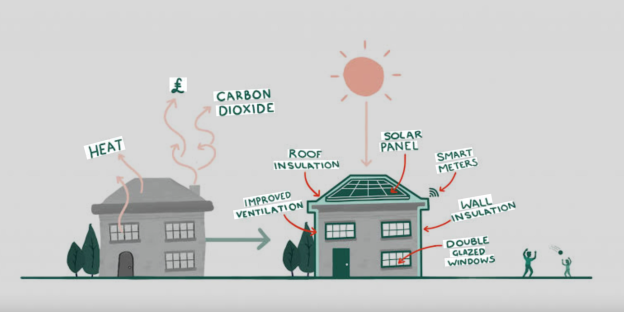
The installation of most Energy-Saving Materials (ESMs)—including insulation, heat pumps, and solar panels—is currently zero-rated (0% VAT). The current status of this relief was put in place until March 31, 2027, and directly benefits energy-efficiency retrofitting. It covers both the labour and the materials when installed by a contractor.

Rachel Reeves’ Budget: Signs on VAT and Retrofit

There are strong indications that Chancellor Rachel Reeves is focusing her Budget not on a broad VAT cut for all refurbishment, but on targeted financial support and adjustments to energy pricing mechanisms to reduce bills and promote retrofitting.

Key signs & speculation of the focus will be on subsidies over broad VAT cuts. The government has repeatedly stressed fiscal responsibility. A blanket cut to 5% VAT on all general renovation (dropping the 20% rate) would be a massive, expensive change that could be seen as breaking the party’s manifesto pledge not to raise the main rates of VAT (though a cut wouldn’t break the pledge, it costs revenue).

The government’s core strategy for greening homes, the Warm Homes Plan, has been focused on direct funding and subsidy schemes (like the Boiler Upgrade Scheme and insulation grants), which can be precisely targeted towards low-income and fuel-poor households.

There is strong speculation that the Chancellor is looking at measures to move environmental levies (like those funding clean energy and some efficiency schemes) off household electricity bills and into general taxation.

This would immediately make electricity cheaper relative to gas, making the running costs of heat pumps (a key retrofit technology) much more attractive and helping to drive the transition away from gas boilers. This is viewed by some as a more effective, structural way to encourage electrification than a broad VAT cut.

At the same time targeted adjustments to Existing Schemes. Reports suggest the Chancellor may be restricting eligibility for certain subsidies, such as the Boiler Upgrade Scheme (for heat pumps), so that they are more focused on households receiving benefits or with lower incomes, in a move to make the funds stretch further and target those in greatest need.

Conclusion on VAT for Refurbishment

While many industry experts (and the construction sector) continue to lobby the Chancellor to scrap the 20% VAT on all labour for refurbishment to genuinely “level the playing field” with new builds and meet climate targets, the current focus is on:

  1. Maintaining the 0% VAT on specific energy-saving materials (like heat pumps and insulation).

  2. Using direct grants/subsidies for deep retrofitting.

  3. Making structural reforms to electricity pricing to encourage the switch to low-carbon heating.

Londoners deserve a “Freezing of Fares” as well

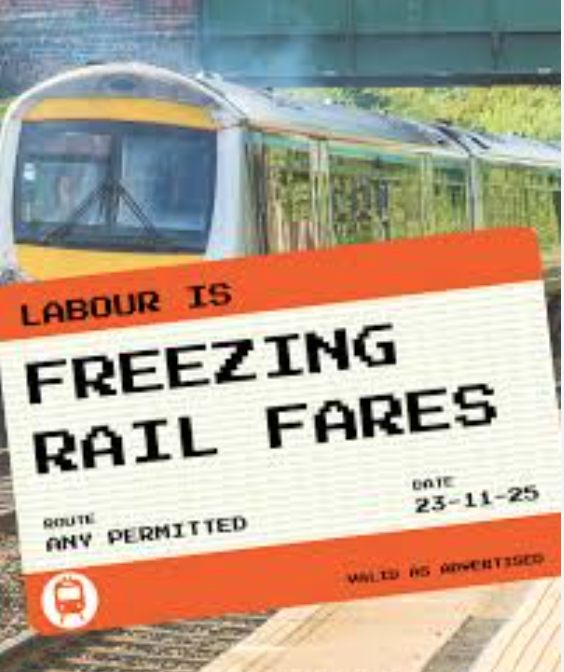
After the Chancellor froze train fares today in her long awaited budget speech for the rest of the country, there is a very good of the same happening in London as well. 

Now the simplest interpretation of this would be TfL keeps fares at current levels rather than implementing the planned 3.6% rise.

A transparent back-of-the-envelope calculation on what a TfL fare freeze would roughly cost begins with TfL passenger (fare) revenue was £5.0 billion in fiscal 2024/25. (This is TfL’s passenger revenue level reported in recent finance material / credit commentary).

Here the calculation would be Passenger revenue × planned increase = cost of not taking that rise. That is  £5,000,000,000 × 0.036 = £180,000,000. So its approximately £180 million per year (rounded) of foregone revenue if passenger revenue is £5 billion and the avoided increase is 3.6%. A useful comparator here is when the Mayor previously identified £123m of GLA funding to freeze fares for a year in an earlier package. 

Alternatively, if TfL instead matched a higher national rail-style freeze (say 4.6% which applies to some regulated fares), and you conservatively treat the whole passenger base as affected by the calculation £5,000,000,000 × 0.046 = £230,000,000. So we have approx £230 million per year in lost revenue in that (pessimistic) case.

Some caveats will of course need to be made, as the real number can differ. Firstly not all fares move by the same % (some are nationally regulated; some TfL sets itself), thus the total loss depends on which fare types are frozen.

Secondly we have the ridership effects — fare freezes can slightly increase journeys (or limit passengers lost to higher fares), changing the yield but l won’t be surprised if TfL’s passenger income is also sensitive to journey counts and ticket mix.

Thirdly, TfL’s published “gross service income” is split by mode (Underground, buses, Elizabeth line, etc.); a more accurate model would apply different % changes to those mode-specific revenues. The 3.6 / 4.6% figures are applied here as a single average for simplicity.

And finally the figures above are annual ones — a one-year freeze costs roughly the amount calculated for that year, as of course multi-year freezes multiply the impact unless offset by other measures (savings, grants).

So in summary a TfL fare freeze that simply cancels a 3.6% planned rise would cost roughly £180m/year, using a £5.0 billion passenger income baseline. If larger regulated increases (4–5%) were avoided across the board the cost could be in the £230m/yr range, or higher if you use a larger passenger income base. This has of course been done before by the Mayor and during a cost of living crisis, you would think it is doable again. It is just a question of what level one should implement against the national trend now set by the Chancellor. 

Furthermore, with TfL projecting a net income of £75 million in the first full financial of ending of the EV exemption from Congestion Charge from the 2nd of January 2026, here is another source of monies to be able to freeze tube fares in London. 


Lisson Green Estate Tower – whats going on?

With consultations for the masterplan of the site Lilestone Street occurring right now around Church St including the WAES facilities, it is worth remembering what was said and promised earlier on in the development process. 

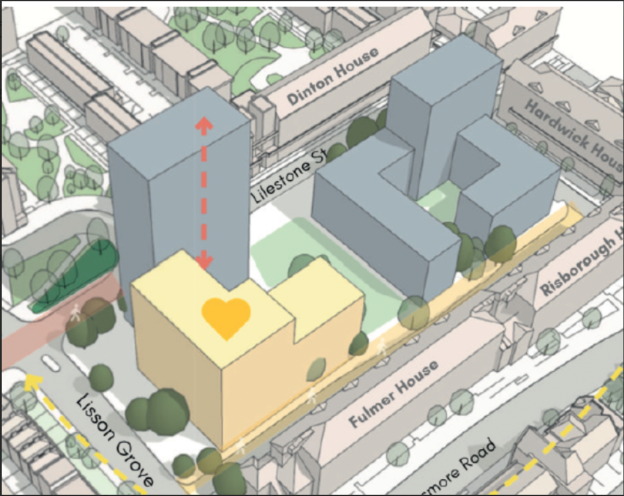
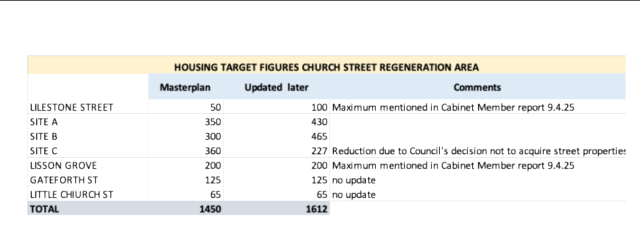
The Masterplan presents Lilestone Street dedicated primarily to the Health & Wellbeing Hub, with a homes target of 50 for the site.  In the Cabinet Member report of 9/4/25 which signs off what is termed the ‘Lisson Grove Programme by local councillor Matt Noble as Cabinet Member for Regeneration ( no longer in post).  It mentions a target of “between 250-300 new homes across Orchardson Street and Lilestone Street”.


The attached table above lists all Masterplan development sites that demonstrates how the housing target figures have shifted over time. As the maximum number of homes agreed by Cabinet is 300 across both sites I entered the original figure for the site originally called “Lisson Grove” at Regent’s Canal: 200 and increased the figure for the development on Lisson Green to 100.

A number of questions arise from what has so far emerged about this site:

1. Do the drawings which include envisaged tower blocks for both sites actually depict 300 homes or a higher number?
2. Why were we not consulted about the plans for a 20+ storey tower (never depicted or mentioned previously) in June or July before they went out for consultation?
3. Why did the consultation focus on layout and function of the hub and not also on the very considerable residential part of the development?
4. If such a massive development, requiring the demolition of two existing blocks and the existing community centre, is indeed planned to take place right at the heart of Lisson Green estate, shouldn’t Lisson Green residents have a say?

Now Hunters Architects have set the gold standard for co-designing sites B and C with the local community, communicating clearly and transparently about all aspects of the development. By contrast, why then with Lisson Grove plans (which diverge enormously from the Masterplan), are being presented in a way that avoided key groups in Church St, in such a manner?

All local stakeholders concerned strongly object to the plans. They especially do not want to see a tower block which reduces the floor space available for the hub. They presented good reasons which the Council should respond to in any plans presented at future workshops. Interestingly the report mentions TARA (Tenants and Residents Association) among the consultees though not the Church Street Ward Neighbourhood Forum, which l am a member. 

In the meantime, some other sites have presented themselves in the locality.  With the recent fires at St Marylebone Sub-Stations along Orchardson St, NW1 has been inactive. The site is really not ideal and should be designated for housing particularly when we have the much bigger St Johns Wood sub-station, along Lisson Grove.  It should probably accommodate between 150-250 homes as well.  While Burne House has been around a lot longer, where its quite clear BT don’t really know what to do with it at all, as it holds a lot of old antiquated equipment in it still! I would of thought a site like that could accommodate a few hundred properties, if not another large hotel on this junction of Marylebone flyover and Edgware Rd should not go amiss. 

As other sites present themselves – St Marylebone Sub-Station &  Burne House just off Bell St – does all the increased density in the ward have to be piggy banked on ones which already have social housing on them? Not withstanding the questions, of how the increased density is going to be managed in the long run anyway in the most densely packed ward in the country.  I would of thought a site like that could accommodate a few hundred properties, if not another large hotel on this junction of Marylebone flyover and 

So finally staff members who tend to give short shrift to stakeholders’ concerns about over-densification, would do well to take on board these considerations urgently. 

Air Pollution – New Delhi worst in the world!

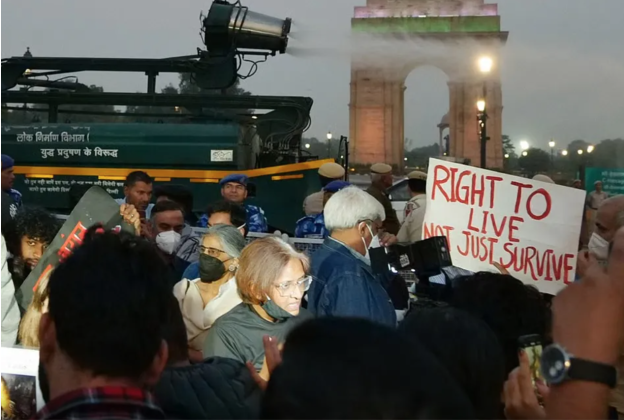
Hundreds gathered in the Indian capital of New Delhi on Sunday to protest against a rising public health crisis brought on by air pollution, demanding government action. The Riot police dispersed the protesters and detained dozens, saying they did not have the right to demonstrate at the symbolic India Gate plaza.This all reflects on how reducing air pollution in New Delhi is a big challenge — it involves many sources, many stakeholders, and both short‐ and long‐term strategies. Here are some of the most promising measures, drawing on recent research, government plans, and expert recommendations.

To pick the best measures, we need to know what are the key sources and causes the pollution beginning with vehicular emissions (especially older diesel/petrol vehicles); dust from roads, construction & demolition (C&D); biomass/solid fuel burning in households; agricultural stubble burning in neighbouring states (Punjab, Haryana); industrial emissions; waste burning, landfill fires, etc and of course seasonal meteorological effects (winter inversion, low wind, etc.)

Air pollution in New Delhi is among the most severe in the world and represents one of the most pressing environmental and public health challenges faced by India. So a focused summary on the air pollution situation in New Delhi. 

The severity of the problem can not be understated. As New Delhi consistently ranks among the most polluted cities globally, with PM2.5 levels (fine particulate matter) often exceeding World Health Organisation (WHO) limits by 10–20 times. During winter months (October–January), air quality frequently enters the “severe” or “hazardous” range, leading to health advisories and emergency measures such as school closures. The Air Quality Index (AQI) often exceeds 400–500, far beyond the “safe” level of 50. The major sources of pollution include firstly vehicular emissions. Delhi has over 10 million vehicles, many of them diesel-powered with Traffic congestion and slow-moving vehicles intensify the pollution. There is also industrial activities with small-scale industries and power plants around Delhi emit significant pollutants, often without effective emission controls. Then we have construction dust as the continuous infrastructure and real estate development contribute heavily to particulate pollution. Biomass & Waste Burning problems include open burning of garbage and biomass is common in and around the city. We also have crop residue burning when each winter, farmers in neighbouring states (Punjab, Haryana, Uttar Pradesh) burn crop stubble, releasing smoke that drifts into Delhi and traps in the city’s air due to stagnant weather conditions. And finally seasonal & meteorological factors involve  low wind speeds and temperature inversion during winter trap pollutants close to the ground.

The health and social impacts are profound beginning with severe respiratory problems, asthma, lung cancer, and cardiovascular diseases increasingly common amongst the natives. Children also suffer reduced lung function while the elderly and outdoor workers face chronic exposure risks. Studies estimate thousands of premature deaths in Delhi each year due to air pollution. And finally the toxic smog also disrupts daily life — reduced visibility, school and construction shutdowns, and flight delays.

We have some government measures and responses beginning with odd-even Vehicle Scheme with temporary restrictions on car usage based on license plate numbers to reduce vehicular emissions. A Ban on Firecrackers, especially around Diwali, to control spikes in pollution. The Graded Response Action Plan (GRAP) with a set of escalating emergency measures when pollution levels cross thresholds (e.g., construction bans, vehicle restrictions). Also the promotion of CNG and Electric Vehicles with Delhi having one of India’s largest fleets of CNG public transport and is promoting e-vehicles. The closure or relocation of polluting industries. and finally tree planting and urban greening initiatives to increase carbon sinks. Yet despite all these efforts, enforcement remains uneven, and many measures are temporary rather than structural.

The broader challenges include the regional nature of the pollution as Delhi’s air quality depends heavily on surrounding states, making local efforts alone insufficient. Policy Coordination as the fragmented governance between city, state, and central authorities has delayed unified action. And finally urban growth as population and vehicle increases continue to outpace pollution control efforts.

So while Delhi has made progress — for instance, phasing out old vehicles and expanding metro infrastructure, the outlook requires  for sustainable improvement requires long-term, multi-state coordination on the cleaner energy transitions; agricultural residue management, green urban planning, and strict emissions enforcement.

New Delhi’s air pollution is a chronic, multi-source crisis exacerbated by regional factors and seasonal weather patterns. It represents both a local and regional governance challenge, demanding coordinated, year-round action to protect public health and the environment.

  • Measure Why It Helps / What Impact Key Challenges / What’s Needed
    Stronger emissions standards + vehicle transition• Enforce vehicle emission norms (e.g. BS-VI in India) fully• Accelerate adoption of electric vehicles, especially two‐wheelers, three‐wheelers, buses• Incentives & restrictions (e.g. ban or tax older polluting vehicles) Vehicles are a major source of PM2.5, NOx, etc. Cleaner cars + EVs reduce local pollution directly. (The Indian Express) Infrastructure cost (charging stations, reliable power), cost of EVs for users, managing lifecycle emissions, ensuring enforcement so that retrofits or maintenance happen.
    Improve and expand public transport + non-motorised transport• More buses, better routes, last-mile connectivity• More metro rail, integration with buses / autos• Expand safe cycling & walking infrastructure Reduces number of private vehicles, especially for short trips. Helps reduce congestion (which itself increases emissions per km). (ORF Online) Requires investment, careful urban planning, removing barriers (e.g. safety, convenience), changing people’s behaviour.
    Control dust from roads & construction• Covering construction materials; using water-sprays / sprinklers• Mechanised sweeping, dust retardant pavements / greenery/verges• Greening roadside areas, planting trees to act as dust sinks Dust is a large contributor (PM10 etc.), especially in the dry/windy seasons. Controlling dust gives immediate improvements. (The Indian Express) Costs, enforcement (builders and contractors must comply), maintaining infrastructure, ensuring sufficient water supply for spraying, dealing with narrow and congested roads.
    Reduce biomass / solid fuel burning• Encourage clean fuels for cooking & heating (LPG, electric, biogas) for households, especially the poor.• Provide incentives & subsidies where needed.• Prevent burning of waste & leaves in urban & semi-urban areas. Household and waste burning is a persistent source of fine particulates (PM2.5) and has serious health impacts. (The Indian Express) Affordability, ensuring regular supply of clean fuel, behaviour change, enforcement. Some communities may lack infrastructure or awareness. Also winter heating demand is a factor.
    Address agricultural stubble burning• Provide alternatives (mechanised removal, happy seeders, bio-decomposers)• Incentives for farmers to alter crop patterns or harvest earlier• Regional coordination (since smoke drifts from outside Delhi too) A big part of seasonal air pollution spikes. Mitigating this can reduce extreme pollution events. (Deutsche Welle) Requires cooperation of multiple states, funding, logistics of equipment, changing traditional practices. Also needs policy incentives, possibly subsidies.
    Stricter industrial & power plant emissions control• Ensure industrial units use proper emission control technologies (filters, scrubbers)• Retire old / inefficient plants; enforce SOx/NOx control measures• Control emissions from brick kilns, coal‐fired plants Industry & power plants contribute pollutants beyond what traffic does, often with continuous emissions. Long-term gains from controls. (ORF Online) Big capital costs, regulatory and oversight challenges, political economy (industries may resist, need compensation or support), ensuring reliability of power supply while phasing out polluters.
    Better waste management• Collect, segregate and process solid waste properly to avoid open burning.• Prevent landfill fires; remediate old dumpsites. Open burning of garbage is a direct source of toxic smoke, particulates. Landfill fires worsen air quality greatly. (Hindustan Times) Institutional capacity, funding, coordination across municipalities, sustained political will. Also public cooperation in waste segregation.
    Policy & enforcement, monitoring• Graded Response Action Plan (GRAP) to enforce temporary measures during high pollution (e.g. limit traffic, ban construction)• Improved air quality monitoring networks, real-time data, early warning systems• Stronger laws, penalties; making sure regulations are actually implemented Even with good plans, lack of enforcement means they don’t work. Real-time data helps trigger timely actions. (ORF Online) Requires institutional capacity, political will, avoiding corruption, making sure citizens are aware & involved, coordination across agencies.
    Awareness, behavioural change• Public education about the health effects of pollution, how to reduce exposure (e.g. masks, staying indoors on bad days)• Encouraging car‐pooling, avoiding unnecessary travel, reducing use of private vehicles • Consumer pressure on industry & services (restaurants, power plants) Behavioural change can amplify the impact of technological measures. Also helps ensure public buy-in so policies are acceptable. (ETHealthworld.com) Takes time; cultural, economic constraints; sometimes inconvenient or costlier. Need consistent messaging and trust.
    Green infrastructure• More trees, green belts, urban forests, green roofs• Green buffering around sources / highways• Landscaping to reduce dust, cool surfaces (heat islands contribute to pollution chemistry) Helps absorb some pollutants, reduce dust, improve microclimate. Co-benefits for aesthetics, heat, health. Space is limited in densely built city; cost; maintenance; selecting appropriate species; ensuring survival (water, soil).
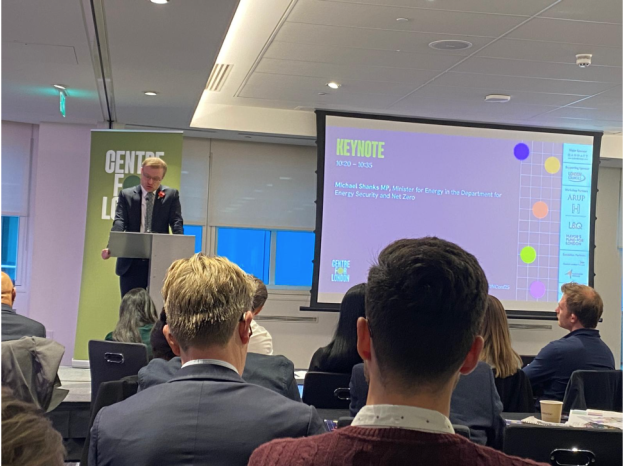
Energy Minister Michael

Powers needed for further decarbonisation in London

It was good to see yesterday how keen professional were for the decarbonising of London, as it is committed to achieving net zero by 2030. The Mayor, London boroughs and local partners are driving action on housing retrofit, clean transport, and green infrastructure. However, l can not help but think current national regulations and fiscal rules limit local delivery. With existing powers, London government can influence only about half of the emissions reductions required. To bridge this gap, specific powers and funding flexibility must be devolved from central government.

So you will find below a list of key powers and policy asks for London from Central government. 

With Planning & Building Standards, devolve power to set higher local energy performance standards for new developments and refurbishments. Simplifying planning for solar PV, EV charging, and retrofits to fast-track local decarbonisation.

With Heat Networks & Local Energy Systems, grant statutory powers to designate Heat Network Zones and require building connections. So as to enable local and community energy suppliers through simplified licensing and local energy trading rights.

With Transport & Streets, extend powers for zero-emission zones, bus franchising, and road user charging to deliver a fully zero-emission public transport network by 2030 particularly clarify authority over kerbside assets for EV and micro-mobility infrastructure rollout.

With Homes & Retrofit, empower boroughs to enforce higher energy efficiency standards in the private rented sector. Providing long-term retrofit funding and borrowing flexibility for council-led and community retrofit programmes.

With Fiscal & Financing flexibility, devolve multi-year capital and revenue funding for net zero programmes. So as to permit green municipal borrowing and local climate bonds, supported by partial business rate retention or local levies.

With Data & Coordination, mandate open access to energy and building data for planning and heat zoning. So as to create a statutory duty for local climate coordination, aligning housing, transport, and energy actions.

The expected outcomes of all this devolution, is faster, cheaper decarbonisation aligned with national targets which should help unlocks £10–15 billion in private investment and 250,000 green jobs by 2030. Thus reducing the long-term national subsidy requirements.

This call to action should include a commit to a Net Zero Local Powers Settlement for London by 2026; embed heat zoning and local energy powers in forthcoming legislation and finally establish a joint GLA–DLUHC–DESNZ task force to agree a devolution roadmap

“Mayor Mamdani” please watch out

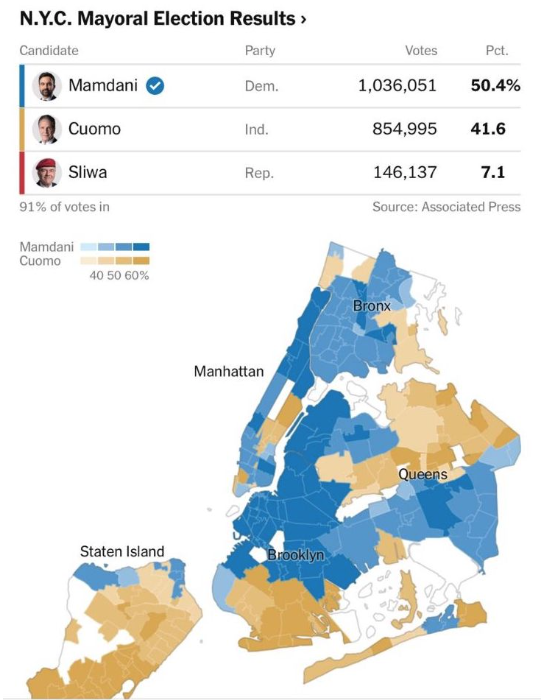
With the truly historic victory on Tuesday night of Zohran Mamdani winning the Mayoralty in New York to become New York City’s, 111th Mayor after some formidable opposition from the likes of billionaires funded attacks on social media and the mainstream media of the US as well, l can’t help but fear some trepidation for him.

Let us be clear this was an incredible result where he came from nowhere in the democratic primaries to become their candidate and then eventually beat his nearest rival the Governor of New York State, Andrew Cuomo who became the Democrats establishment candidate. He also gives my relatives in New York some relief from all the stresses of living the American dream in recent times though many of them have been there since the mid-1970s.

Now being the sister city of Greater London, there are some useful comparisons to be made in the analysis of the vote. For example, like in London, you need over 1 million votes to win the Mayoralty of New York. Not surprising as we have similar populations of just under 9 million when our population is distributed more widely and in New York is concentrated in a smaller area with a much higher population density. He managed to get just over a million with 1,036,051 making up 50.4 per cent of the vote. Whilst we have a crazy 32 boroughs, New York City has just 5 boroughs and he did particularly well in Manhattan, the Bronx and Brooklyn.


But there is a lesson from history, from our shores they will need to be digested. When Ken Livingstone was elected leader of Greater London Council (GLC) in 1981 with a platform to have fares cut; invest in housing and public services, increased wages and finishing the Thames Barrier to protect London from floods, it was not dissimilar to Mandani’s electoral mandate. Yet Margaret Thatcher, the PM of the day, found their antics too much to tolerate. Seeing the huge figures of the number of unemployed in the country that could be seen from across the river at County Hall from the Palace of Westminster was clearly too much for her. She duly went along and abolished the GLC and sold County Hall which had stood as the home of the London government since 1888.

Now if Trump goes for Mamdani, l can’t help but think he’ll do something similar and trash the institution of the Mayor of New York office as well along with Gracie’s Mansion and New York City Hall. Since becoming the President again, he has for example stopped New York’s very own congestion charging regime in Lower Manhattan. Even though New York City’s congestion pricing had cut pollution and traffic in its first six months noticeably. The Trump administration said the federal government has jurisdiction over highways leading into the city and revoked its approval of the controversial program over concerns it unfairly burdens working-class residents in the region. So clearly Trump keeps an eye on matters in his old home city of New York, where his father made the family fortune. This on top of the abuse Trump will give Mamdani anyway.

So before his inauguration in January to take up his office, he’ll have plenty to think about on this front. We of course should join any uproar against any such attempt as we look at our own history and the indeedable mark it made on London and how we had been governed since the late eighties.


Property taxes in NYC & London

With the huge victory of Zohran Mamdani in the New York Mayoral contest this week, attention has been drawn to his tax policies in regards to getting those with broader shoulders to taking up more of the burden. His only real means would be raises in property taxes, which is worth discussing when compared to London. 

In New York City, annual property taxes are generally higher than in London, where homeowners pay relatively low annual Council Tax. Now New York City’s property tax system uses effective tax rates that are generally around 0.88% of the market value for residential properties (Tax Class 1: 1- to 3-family homes). However, the actual rates can vary by borough:

Brooklyn (Kings County): ~0.68%
Manhattan (New York County): ~0.98%
Queens (Queens County): ~0.87%
Staten Island (Richmond County): ~0.92%
Bronx (Bronx County): ~1.23%

Taxes are calculated based on an assessed value, which for Class 1 properties is fixed at 6% of the market value, subject to state law limits on how much it can increase annually (capped at 6% per year or 20% over five years). This system often results in a lower effective tax rate compared to the actual market value, and can be regressive, with lower-valued homes sometimes having a higher effective rate than high-valued ones.

London’s annual property tax, known as Council Tax, is significantly lower than typical US property taxes. The amount depends on the property’s valuation band, set by the local borough (e.g., City of London, Westminster, Camden). Average annual bills are generally within the range of £780 to over £1,500 per year. For example:

Westminster: ~£781 per year
City of London: ~£1,374 per year
Islington: ~£1,520 per year

So in comparison, we have two quite different property tax regime, on either side of the pond. In New York, the calculation basis of the assessed value (6% of market value for residential homes), is multiplied by a tax rate Property valuation band set by local borough. Typical this means in New York, the annual cost are significantly higher, with an average effective rate of ~0.88% of market value (e.g., a home valued at $500,000 might have an annual bill around $4,400) Whilst in London, we have significantly lower annual bills, typically ranging from £780 to £1,500+ per year regardless of current market value.  So the key difference is the higher ongoing annual costs. Much higher initial purchase taxes (Stamp Duty Land Tax – SDLT), but lower annual costs.

Overall, while London imposes much higher transaction taxes (Stamp Duty Land Tax) when a property is purchased, the annual property tax (Council Tax) is considerably less than the annual property tax burden in New York City